Showing posts with label monteverde. Show all posts

Thursday, November 21, 2019

Dreams of Manakins Dancing Around in my Head

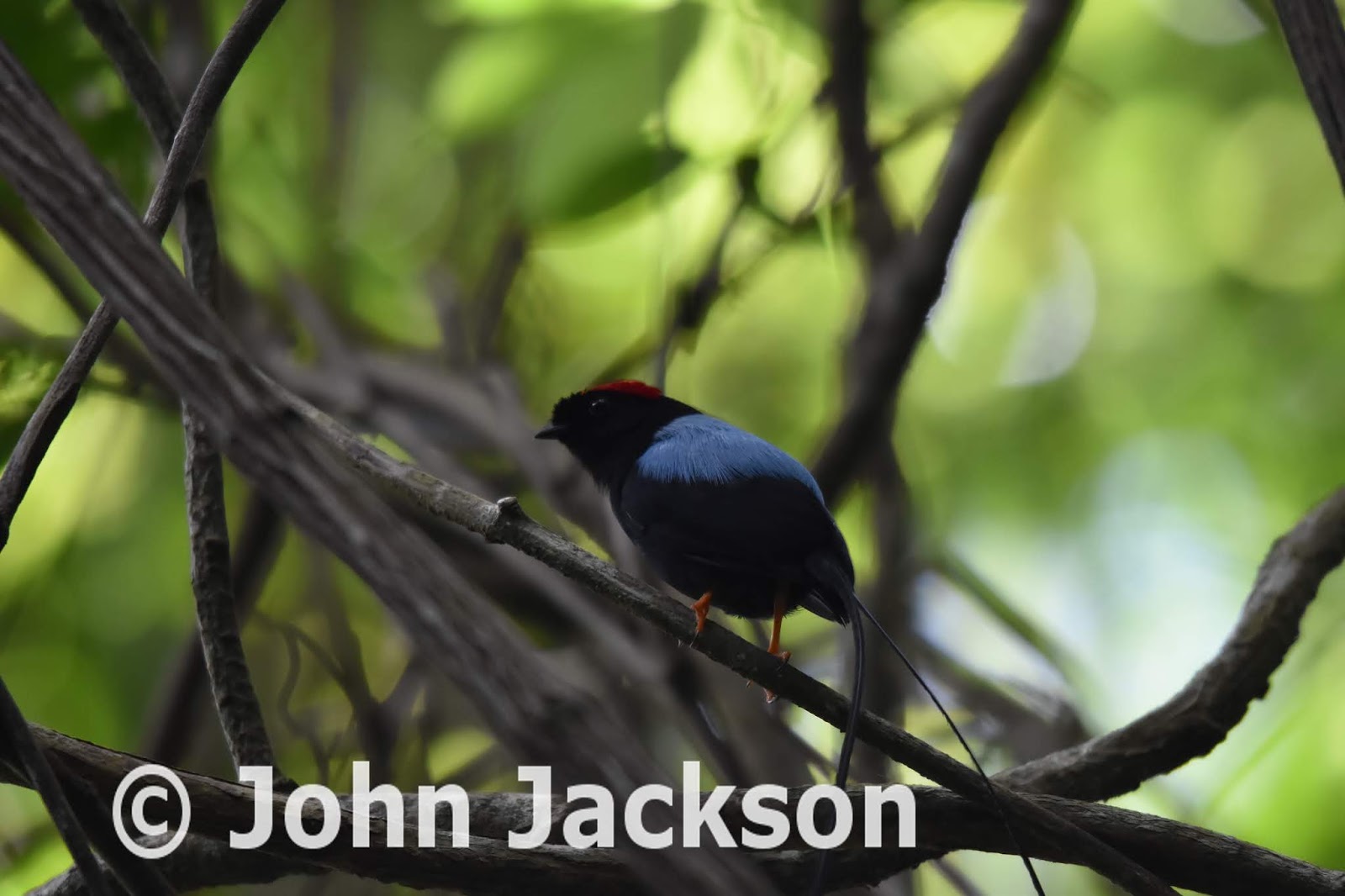
Long-tailed Manakin (Chiroxiphia linearis) male perching on a tree in Santuario Ecológico, Monteverde
Birds are amazing animals; I think it is pretty obvious I think so, by how many posts on this blog are about birds. With over 10,000 different species their are many, many birds to talk about. One group though, is particularly marvelous and I have long wanted to see, the manakins. Many of the birds in this group dance in elaborate courtship displays that are wonders to behold.
A Long-tailed Manakin male pair perched in the canopy of the Bajo del Tigre section of Children's Eternal Rainforest, Monteverde
Manakin, not mannequin, though the etymology of both comes from the same Dutch root for “little man”. Manakins are a frugivorous neotropical bird family. There are about 60 different species found from Mexico to Southern Brazil. They have a very distinctive syrinx, which is where songbirds produce sound. This gives them the potential to make many more complex calls then there close relatives, which have simpler syrinxes. (This will be important later) This all adds up with their dancing displays to make them very exciting, and easily catching the eyes of tropical ornithologists. I think I first really remember hearing about them on PBS Nature’s 3 part Deep Jungle series, where the mating display of one species was described by a researcher.
Blue-crowned Manakin (Lepidothrix coronata) in the Wet forest of the Osa Peninsula
With my adventure in Costa Rica I ended up seeing three manakin species. Two of them on the Osa Peninsula. The Osa peninsula is famous for Corcovado National Park, sometimes called the most biologically intense place on earth. These hot coastal wet forests are buzzing with activity with all kinds of insects about, monkeys swinging through the trees, snakes slithering through the undergrowth, and birds flying around and calling. Birding and photography is really hard with all the light filtering through the canopy, and dense foliage that obscures everything off trail. The first species I got to see was the blue-crowned manakin. Black with a beautiful sapphire crest, it is a very handsome bird. Immediately upon seeing it I could tell it was a manakin, which was exciting as it was my first time beholding one live. The next day on a hike, I passed through the lek of one of the coolest manakins. 
A male Red-capped Manakin (Ceratopipra mentalis) in the Wet Forest of the Osa Peninsula. This bird is known for its remarkable "moonwalking" display.
A lek is an aggregation of males with the goal of attracting females. It likely gives each male an advantage, being ne
ar to best males, and possibly snagging a female, though actually mating in a lek is quite rare. Here in the wet forests of the Osa Peninsula I saw the most incredible sight, the dance of the red-capped manakin. This bird is famous for shuffling backward in a movement that looks a lot like a moonwalk. While it does this it makes a buzzing call, and a loud click produced by the wings. It was so exciting to see what has to be considered one of the most amazing avian displays right in front of you.
A Long-tailed Manakin male perched in the canopy of the Bajo del Tigre section of Children's Eternal Rainforest, Monteverde
The third and final manakin was up in the rain shadow forests of Monteverde. Below the cloud forest, it is a drier but very tangled forest. This is the haunt of the long-tailed manakin. This is a spectacular little bird with two long tail feathers, a red cap and a bright blue back. They can be tricky to spot in the very thick canopy and undergrowth, but they are easy to hear with their loud distinctive toledo call which rings through the forest. What makes them really special is that they lek in an alpha-beta pair of males that work as a team to court females. The alpha gets pretty much all matings, but the beta is usually a younger bird that will inherit the lek when the alpha dies. Their courtship is very complex and it was really cool to observe the different phases. They also have very complex vocal cues that are part of the different phases of the display, which is where the special syrinx of manakin is useful.  The teeamoo call is used to call the other male to a perch in the lower canopy. Then they make a series of popping wit calls, this seems to synchronize the males so they can synchronize the toledo which is a duet. This call is what attract females in. Once she is in the area, the males move to the display perch low to the ground. They then call the female down with the owng call. Once she is in position they do there dancing display. They leapfrog over each other making this really odd sound, the call nyanyownh. If she stays longer they co quiet and go to the butterfly flight where they fly back and forth from the display perch into the forest showing off their almost morpho-like back.
Two male Long-tailed Manakins in the middle of their leapfrogging display in the understory of the Bajo del Tigre section of the Children's Eternal Rainforest, Monteverde.

I had come to Costa Rica on a study abroad program through the Council on International Educational Exchange (CIEE) on a tropical biology and conservation program over the summer. This program, which began in the early 90s, has been exposing students to the tropics and allowing them to do independent research. For my study, I looked at the effect of toledo playback at varying distances. I recorded toledo duets, and then made a five minute recording and then recorded the response of birds at the distances of 5-10 and 25 meters, and well I did not get enough data. It was a hard study, I had to locate the display perches of Manakins, which took a lot of time to locate. Then as it turned out, the birds don’t really respond to toledo with other calls; they only slightly change the intercall frequency of their own toledo duets, which to get a good answer requires each recording to get toledo
duets, and that did not happen.
A Long-tailed Manakin male perched on a branch in Santuario Ecológico, Monteverde

Despite my study having some serious methods problems it was a very valuable experience on setting up a study, and to make sure if I change what you are measuring after you start to make sure the new system works with existing methods. (which I think was my problem) It was also a good experience to have the stress of having to write a paper with not much to say, I think that will be useful for managing stress when I actually have a paper with interesting results. If you want to check out my research go to https://cieetropicalecologyandconservation.files.wordpress.com/2019/08/summer2019book.pdf (it is at the very end) I had a great time in Costa Rica and I would like to thank the wonderful staff of CIEE Monteverde for the amazing experience. 

Source
"mannequin". The American Heritage Dictionary of the English Language. Houghton Mifflin Company. 2004. Retrieved 2009-08-07.
New Oxford American Dictionary (2nd ed., 2005), p. 1032.
Prum, Richard O.; Snow, David W. (2003). "Manakins". In Perrins, Christopher (ed.). The Firefly Encyclopedia of Birds. Firefly Books. pp. 434–437. ISBN 978-1-55297-777-4.
McDevitt, M. K., C. I. Rodríguez-Flores, C. A. Soberanes-González, and M. d. C. Arizmendi (2011). Red-capped Manakin (Ceratopipra mentalis), version 1.0. In Neotropical Birds Online (T. S. Schulenberg, Editor). Cornell Lab of Ornithology, Ithaca, NY, USA. https://doi.org/10.2173/nb.recman1.01
Trainer, J. M. and D. B. McDonald. 1993. Vocal repertoire of the Long-Tailed Manakin and its relation to male-male cooperation. Condor 95: 769-781.

Friday, August 30, 2019

A Resplendent Nightmare

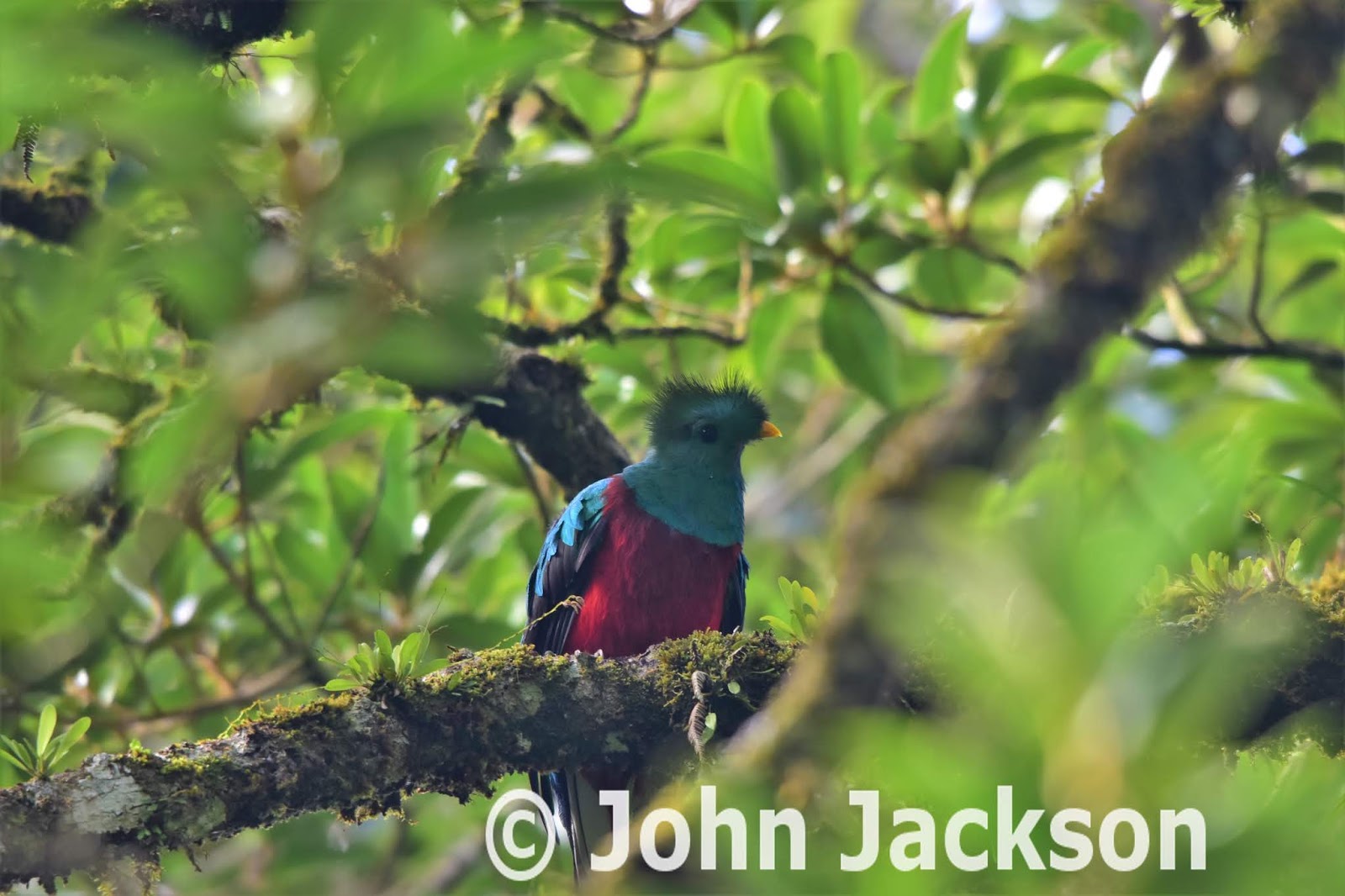
The Resplendent Quetzal, one of the most beautiful and sought after birds in the world. Found only in the Cloud Forests of Costa Rica, it feeds on wild avocado.
The resplendent quetzal (Pharomachrus mocinno) is a living jewel of the mesoamerican cloud forest. Few birds can rival the males beauty: iridescent emerald feathers, a crimson breast, and tail feathers longer than the whole body. Well, they are actually modified upper tail coverts and not the rectrices, but that makes them almost more spectacular, with a more flowy appearance. This bird appears almost impossible, yet it exists, and people have taken notice for a very long time.
As the name suggests, the resplendent quetzal is associated with Quetzalcoatal, the mesoamerican snake deity. Its long tail lends it something of a serpentine look, I guess. The long feathers themselves were used in headdresses of nobility. They were apparently collected from live birds, releasing the unfortunate male after they had finished plucking the plumes they wanted. The term quetzal came to mean sacred or precious in some parts of mesoamerica.
Another look at the head of a male quetzal, also showing the crimson breast color.
This divine bird captured the imagination of Europeans, and after centuries, particularly bird-watchers. This bird is just one of those must see species. I have to say for myself it is easily in my top five birds globally I wanted to see, in a list with other avian legends and other oddities. This bird probably helped put mesoamerican cloud forests on the tourism map, and walking Monteverde you see its image everywhere. I think even non-birders want to see this creature, as it is a natural wonder much like Arches and other rock formations of Utah.
A female resplendent quetzal. Not as showy as the males, but still a very nice looking trogon.

My quest to see a quetzal is not the most daring adventure I have had to embark on. It didn’t involve running up a hill with poison ivy to see an elegant trogon, taking a jeep down an insane jungle road before a hard hike in a remote part of Kauai to glimpse a puaiohi, or go traipsing into the jungle following army ants to see the ocellated antbird. If anything it was pretty straightforward. Ebird told me the place to check out was Curi-cancha reserve next to the Monteverde cheese factory. So on the 4th of July after finishing an exam, I headed out. I found Monteverde is a very walkable place. (the world famous Monteverde Cloud Forest Reserve is a bit further and best to just take a taxi there, but we will get to this reserve later) I walked into the main entrance paid my fee, (Monteverde is the land of paying about $15 to do stuff) and the man there circled an area on the trail map and said look for quetzals there. Well, I walked up filled with anticipation, and arrived at the spot to find a family already there, and they had a quetzal in a wild avocado tree. It was a female, a stunning trogon, but I still really wanted to see the male bird with its incredible plumage. I hung around a little, walked the cloud forest, and learned if I wanted to see a male it sounded like I needed to go early.
A male quetzal from the front, red breast, and his long tail coverts blowing in the wind.

So a few days later I gathered a small group of other students excited to see this bird. We arrived early, and again a family was already there, and had just seen a male. I saw something torpedoing through the trees. These birds are hard to spot when not moving, on par with my experience with trogons, fortunately with so many people I quickly had the exact spot described to me. It was a truly amazing bird, with long feathers blowing in the wind. I was quite ecstatic to finally see and photograph this incredible bird. We hung around, as a few groups came through and took a look.
The back veiw of a male quetzal, his tail coverts crossing in a a very fluid way.
Weeks later I made a return trip, because why not. I arrived to what else but a group that already had a female bird in their scopes. At this point I realized that finding a quetzal was literally just finding a group that had one. Those who have seen the movie The Big Year may get this; I would refer to this as “Skua Birding” or just letting others do the work of spotting, and then getting the bird. This time though I actually was spotting quetzals, while other people looked at the one the guides had seen. The area probably a total of five. Now after the excitement of first seeing these gems, I go to observe these birds and get a feel for their movement and behavior. Like all trogons they slowly move and cock their heads, which I heard a guide call scanning. Basically looking around for food. They also are quite clumsy in the air, sort of wildly flapping about. I got to look at them even closer than before. The thing was, that since the last time I had been in Curi-cancha the male had shed his tail. They looked less exotic and regal, and more cute. I stayed around for some time and many groups came through, and listened to the same speal about the quetzal. Eventually some thirty people stood around, but the quetzal area here is quite open and though it felt crowded, it wasn’t too intense.
Where did my tail go? This male has lost the long tail coverts that makes this species so famous.

In my last few days in Monteverde I finally made my way to the Monteverde Cloud Forest Preserve. This place was different. Hiking the upper trails it is a magnificent place, wandering the magical forest swallowed by the clouds. I was definitely reminded of Hawaiian Cloud Forest. Except, it was packed. I had not seen crowds like this for over a month. A line to get a ticket, a line to get in. When walking a path, a group had formed as they had spotted the quetzal. Unlike Curi-cancha with its wide open area, this was on a narrow path. It was then that all my musings of the similarities between Moab and Monteverde kind of connected. Anyone who has not visited Arches National Park in a while may be shocked by the amount of people trying to get in. I am down in the Moab area quite often, but almost never venture into the park. Maybe January. The line to get in by car is often hundreds of feet long and takes a while. Delicate arch is a nightmare of a hike, with a constant procession of visitors going to grab their selfie under Utah’s most famous landmark. The quetzal seems to be something everyone who comes to monteverde seems to want to see. I am of course no exception, but over my time in the area and seeing the quetzals four times, I became more and more aware of this. Also might have to do with my irritation at not getting a great angle at a prong-billed barbet that came by.
A crowd of visitors and guides in the Monteverde Cloud Forest Reserve looking at a handful of quetzals in the mist.

Possibly just because I want to go back, but there could be an interesting study on the effects of birding in Monteverde. It is one of those few places, like Madera Canyon, that are so heavily trafficked by birders that we could get a real look on how this kind of ecotourism affects nature. Of course this popularity is probably not a bad thing, the desire to see a wild quetzal probably plays an important part in the amount of reserves in the Monteverde area; and fortunately trails only cover a fraction of the cloud forest, so there are quetzals somewhere in the mist not bothered by crowds gawking at them.

This place feels like a dream... Not sure what was up with the shafts of light my camera picked up, but it looks magical in the moss shrouded branches of gnarled cloud forest trees.

Evans, Susan Toby; David L. Webster (2000). Archaeology of Ancient Mexico and Central America: An Encyclopedia. Kahurangi Press. pp. 265–66. ISBN 978-0815308874. Retrieved 2015-03-22.