 |
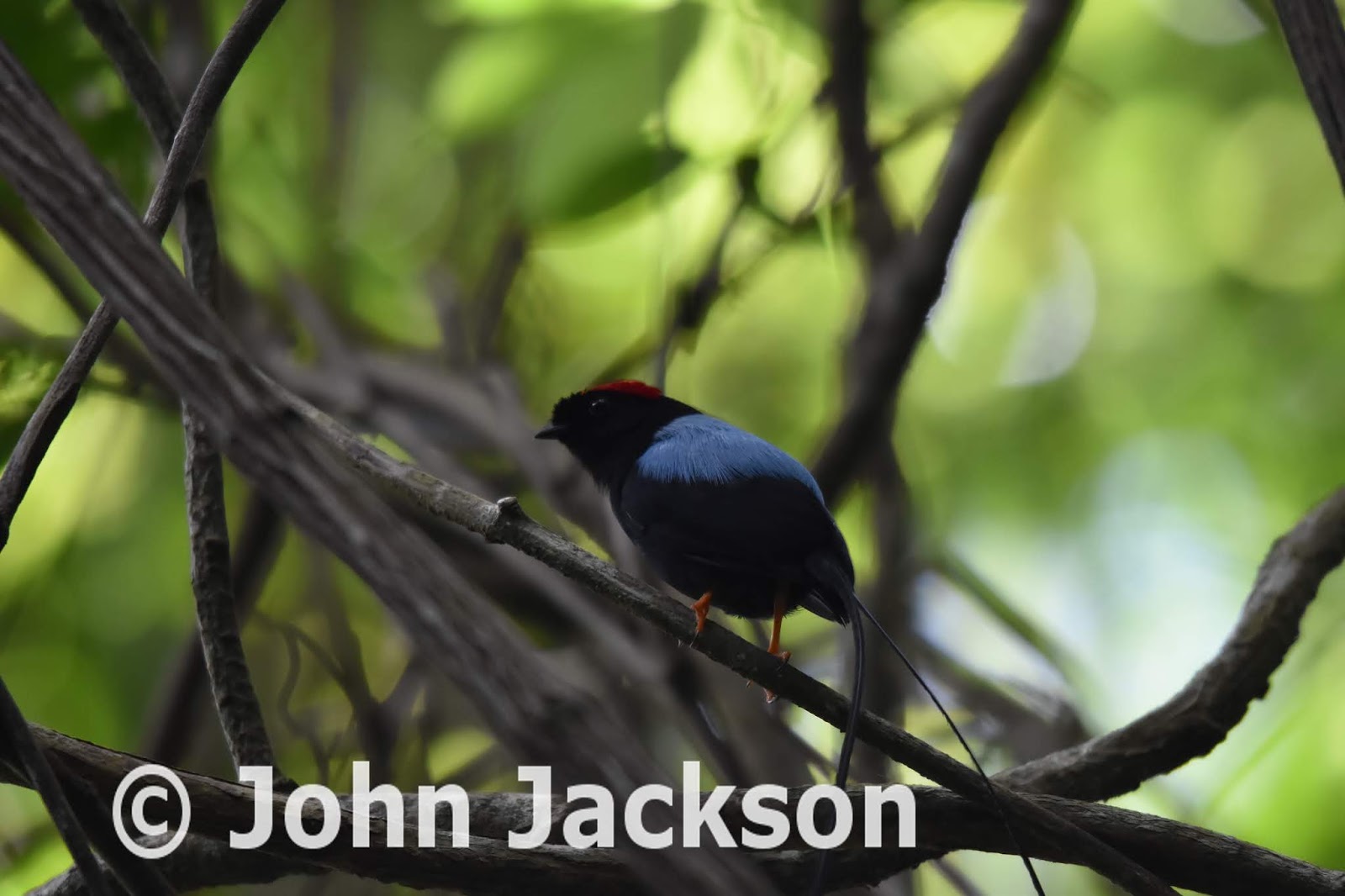
| Long-tailed Manakin (Chiroxiphia linearis) male perching on a tree in Santuario Ecológico, Monteverde |
 |
| A Long-tailed Manakin male pair perched in the canopy of the Bajo del Tigre section of Children's Eternal Rainforest, Monteverde |
Manakin, not mannequin, though the etymology of both comes from the same Dutch root for “little man”. Manakins are a frugivorous neotropical bird family. There are about 60 different species found from Mexico to Southern Brazil. They have a very distinctive syrinx, which is where songbirds produce sound. This gives them the potential to make many more complex calls then there close relatives, which have simpler syrinxes. (This will be important later) This all adds up with their dancing displays to make them very exciting, and easily catching the eyes of tropical ornithologists. I think I first really remember hearing about them on PBS Nature’s 3 part Deep Jungle series, where the mating display of one species was described by a researcher.
 |
| Blue-crowned Manakin (Lepidothrix coronata) in the Wet forest of the Osa Peninsula |
With my adventure in Costa Rica I ended up seeing three manakin species. Two of them on the Osa Peninsula. The Osa peninsula is famous for Corcovado National Park, sometimes called the most biologically intense place on earth. These hot coastal wet forests are buzzing with activity with all kinds of insects about, monkeys swinging through the trees, snakes slithering through the undergrowth, and birds flying around and calling. Birding and photography is really hard with all the light filtering through the canopy, and dense foliage that obscures everything off trail. The first species I got to see was the blue-crowned manakin. Black with a beautiful sapphire crest, it is a very handsome bird. Immediately upon seeing it I could tell it was a manakin, which was exciting as it was my first time beholding one live. The next day on a hike, I passed through the lek of one of the coolest manakins.
 |
| A male Red-capped Manakin (Ceratopipra mentalis) in the Wet Forest of the Osa Peninsula. This bird is known for its remarkable "moonwalking" display. |
A lek is an aggregation of males with the goal of attracting females. It likely gives each male an advantage, being ne
ar to best males, and possibly snagging a female, though actually mating in a lek is quite rare. Here in the wet forests of the Osa Peninsula I saw the most incredible sight, the dance of the red-capped manakin. This bird is famous for shuffling backward in a movement that looks a lot like a moonwalk. While it does this it makes a buzzing call, and a loud click produced by the wings. It was so exciting to see what has to be considered one of the most amazing avian displays right in front of you.
ar to best males, and possibly snagging a female, though actually mating in a lek is quite rare. Here in the wet forests of the Osa Peninsula I saw the most incredible sight, the dance of the red-capped manakin. This bird is famous for shuffling backward in a movement that looks a lot like a moonwalk. While it does this it makes a buzzing call, and a loud click produced by the wings. It was so exciting to see what has to be considered one of the most amazing avian displays right in front of you.
 |
| A Long-tailed Manakin male perched in the canopy of the Bajo del Tigre section of Children's Eternal Rainforest, Monteverde |
The third and final manakin was up in the rain shadow forests of Monteverde. Below the cloud forest, it is a drier but very tangled forest. This is the haunt of the long-tailed manakin. This is a spectacular little bird with two long tail feathers, a red cap and a bright blue back. They can be tricky to spot in the very thick canopy and undergrowth, but they are easy to hear with their loud distinctive toledo call which rings through the forest. What makes them really special is that they lek in an alpha-beta pair of males that work as a team to court females. The alpha gets pretty much all matings, but the beta is usually a younger bird that will inherit the lek when the alpha dies. Their courtship is very complex and it was really cool to observe the different phases. They also have very complex vocal cues that are part of the different phases of the display, which is where the special syrinx of manakin is useful. The teeamoo call is used to call the other male to a perch in the lower canopy. Then they make a series of popping wit calls, this seems to synchronize the males so they can synchronize the toledo which is a duet. This call is what attract females in. Once she is in the area, the males move to the display perch low to the ground. They then call the female down with the owng call. Once she is in position they do there dancing display. They leapfrog over each other making this really odd sound, the call nyanyownh. If she stays longer they co quiet and go to the butterfly flight where they fly back and forth from the display perch into the forest showing off their almost morpho-like back.
 |
| Two male Long-tailed Manakins in the middle of their leapfrogging display in the understory of the Bajo del Tigre section of the Children's Eternal Rainforest, Monteverde. |
I had come to Costa Rica on a study abroad program through the Council on International Educational Exchange (CIEE) on a tropical biology and conservation program over the summer. This program, which began in the early 90s, has been exposing students to the tropics and allowing them to do independent research. For my study, I looked at the effect of toledo playback at varying distances. I recorded toledo duets, and then made a five minute recording and then recorded the response of birds at the distances of 5-10 and 25 meters, and well I did not get enough data. It was a hard study, I had to locate the display perches of Manakins, which took a lot of time to locate. Then as it turned out, the birds don’t really respond to toledo with other calls; they only slightly change the intercall frequency of their own toledo duets, which to get a good answer requires each recording to get toledo
duets, and that did not happen.
 |
| A Long-tailed Manakin male perched on a branch in Santuario Ecológico, Monteverde |
Despite my study having some serious methods problems it was a very valuable experience on setting up a study, and to make sure if I change what you are measuring after you start to make sure the new system works with existing methods. (which I think was my problem) It was also a good experience to have the stress of having to write a paper with not much to say, I think that will be useful for managing stress when I actually have a paper with interesting results. If you want to check out my research go to https://cieetropicalecologyandconservation.files.wordpress.com/2019/08/summer2019book.pdf (it is at the very end) I had a great time in Costa Rica and I would like to thank the wonderful staff of CIEE Monteverde for the amazing experience.
Source
"mannequin". The American Heritage Dictionary of the English Language. Houghton Mifflin Company. 2004. Retrieved 2009-08-07.
New Oxford American Dictionary (2nd ed., 2005), p. 1032.
Prum, Richard O.; Snow, David W. (2003). "Manakins". In Perrins, Christopher (ed.). The Firefly Encyclopedia of Birds. Firefly Books. pp. 434–437. ISBN 978-1-55297-777-4.
McDevitt, M. K., C. I. Rodríguez-Flores, C. A. Soberanes-González, and M. d. C. Arizmendi (2011). Red-capped Manakin (Ceratopipra mentalis), version 1.0. In Neotropical Birds Online (T. S. Schulenberg, Editor). Cornell Lab of Ornithology, Ithaca, NY, USA. https://doi.org/10.2173/nb.recman1.01
Trainer, J. M. and D. B. McDonald. 1993. Vocal repertoire of the Long-Tailed Manakin and its relation to male-male cooperation. Condor 95: 769-781.