Friday, August 30, 2019

A Resplendent Nightmare

The Resplendent Quetzal, one of the most beautiful and sought after birds in the world. Found only in the Cloud Forests of Costa Rica, it feeds on wild avocado.
The resplendent quetzal (Pharomachrus mocinno) is a living jewel of the mesoamerican cloud forest. Few birds can rival the males beauty: iridescent emerald feathers, a crimson breast, and tail feathers longer than the whole body. Well, they are actually modified upper tail coverts and not the rectrices, but that makes them almost more spectacular, with a more flowy appearance. This bird appears almost impossible, yet it exists, and people have taken notice for a very long time.
As the name suggests, the resplendent quetzal is associated with Quetzalcoatal, the mesoamerican snake deity. Its long tail lends it something of a serpentine look, I guess. The long feathers themselves were used in headdresses of nobility. They were apparently collected from live birds, releasing the unfortunate male after they had finished plucking the plumes they wanted. The term quetzal came to mean sacred or precious in some parts of mesoamerica.
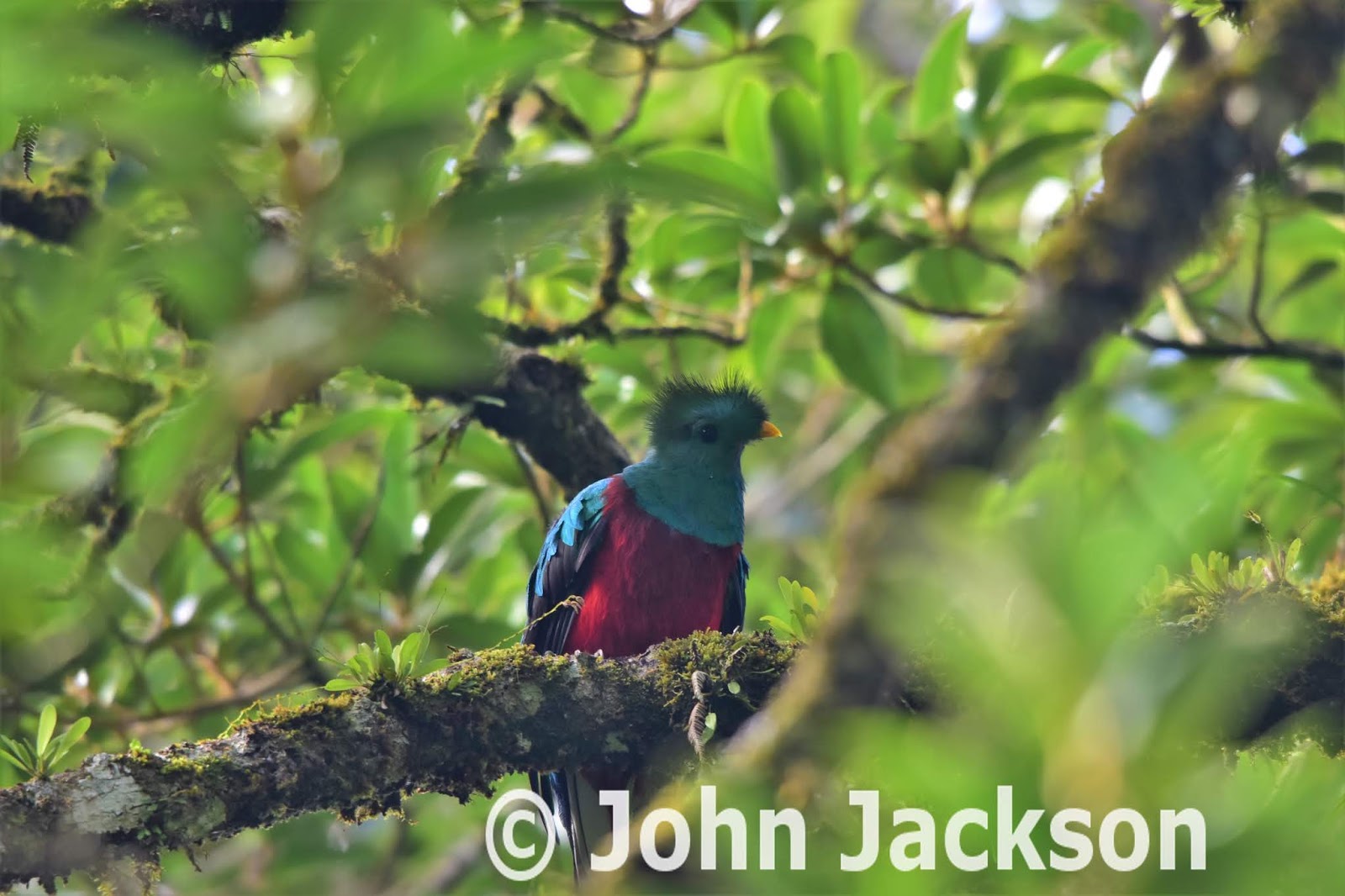
Another look at the head of a male quetzal, also showing the crimson breast color.
This divine bird captured the imagination of Europeans, and after centuries, particularly bird-watchers. This bird is just one of those must see species. I have to say for myself it is easily in my top five birds globally I wanted to see, in a list with other avian legends and other oddities. This bird probably helped put mesoamerican cloud forests on the tourism map, and walking Monteverde you see its image everywhere. I think even non-birders want to see this creature, as it is a natural wonder much like Arches and other rock formations of Utah.
A female resplendent quetzal. Not as showy as the males, but still a very nice looking trogon.

My quest to see a quetzal is not the most daring adventure I have had to embark on. It didn’t involve running up a hill with poison ivy to see an elegant trogon, taking a jeep down an insane jungle road before a hard hike in a remote part of Kauai to glimpse a puaiohi, or go traipsing into the jungle following army ants to see the ocellated antbird. If anything it was pretty straightforward. Ebird told me the place to check out was Curi-cancha reserve next to the Monteverde cheese factory. So on the 4th of July after finishing an exam, I headed out. I found Monteverde is a very walkable place. (the world famous Monteverde Cloud Forest Reserve is a bit further and best to just take a taxi there, but we will get to this reserve later) I walked into the main entrance paid my fee, (Monteverde is the land of paying about $15 to do stuff) and the man there circled an area on the trail map and said look for quetzals there. Well, I walked up filled with anticipation, and arrived at the spot to find a family already there, and they had a quetzal in a wild avocado tree. It was a female, a stunning trogon, but I still really wanted to see the male bird with its incredible plumage. I hung around a little, walked the cloud forest, and learned if I wanted to see a male it sounded like I needed to go early.
A male quetzal from the front, red breast, and his long tail coverts blowing in the wind.

So a few days later I gathered a small group of other students excited to see this bird. We arrived early, and again a family was already there, and had just seen a male. I saw something torpedoing through the trees. These birds are hard to spot when not moving, on par with my experience with trogons, fortunately with so many people I quickly had the exact spot described to me. It was a truly amazing bird, with long feathers blowing in the wind. I was quite ecstatic to finally see and photograph this incredible bird. We hung around, as a few groups came through and took a look.
The back veiw of a male quetzal, his tail coverts crossing in a a very fluid way.
Weeks later I made a return trip, because why not. I arrived to what else but a group that already had a female bird in their scopes. At this point I realized that finding a quetzal was literally just finding a group that had one. Those who have seen the movie The Big Year may get this; I would refer to this as “Skua Birding” or just letting others do the work of spotting, and then getting the bird. This time though I actually was spotting quetzals, while other people looked at the one the guides had seen. The area probably a total of five. Now after the excitement of first seeing these gems, I go to observe these birds and get a feel for their movement and behavior. Like all trogons they slowly move and cock their heads, which I heard a guide call scanning. Basically looking around for food. They also are quite clumsy in the air, sort of wildly flapping about. I got to look at them even closer than before. The thing was, that since the last time I had been in Curi-cancha the male had shed his tail. They looked less exotic and regal, and more cute. I stayed around for some time and many groups came through, and listened to the same speal about the quetzal. Eventually some thirty people stood around, but the quetzal area here is quite open and though it felt crowded, it wasn’t too intense.
Where did my tail go? This male has lost the long tail coverts that makes this species so famous.

In my last few days in Monteverde I finally made my way to the Monteverde Cloud Forest Preserve. This place was different. Hiking the upper trails it is a magnificent place, wandering the magical forest swallowed by the clouds. I was definitely reminded of Hawaiian Cloud Forest. Except, it was packed. I had not seen crowds like this for over a month. A line to get a ticket, a line to get in. When walking a path, a group had formed as they had spotted the quetzal. Unlike Curi-cancha with its wide open area, this was on a narrow path. It was then that all my musings of the similarities between Moab and Monteverde kind of connected. Anyone who has not visited Arches National Park in a while may be shocked by the amount of people trying to get in. I am down in the Moab area quite often, but almost never venture into the park. Maybe January. The line to get in by car is often hundreds of feet long and takes a while. Delicate arch is a nightmare of a hike, with a constant procession of visitors going to grab their selfie under Utah’s most famous landmark. The quetzal seems to be something everyone who comes to monteverde seems to want to see. I am of course no exception, but over my time in the area and seeing the quetzals four times, I became more and more aware of this. Also might have to do with my irritation at not getting a great angle at a prong-billed barbet that came by.
A crowd of visitors and guides in the Monteverde Cloud Forest Reserve looking at a handful of quetzals in the mist.

Possibly just because I want to go back, but there could be an interesting study on the effects of birding in Monteverde. It is one of those few places, like Madera Canyon, that are so heavily trafficked by birders that we could get a real look on how this kind of ecotourism affects nature. Of course this popularity is probably not a bad thing, the desire to see a wild quetzal probably plays an important part in the amount of reserves in the Monteverde area; and fortunately trails only cover a fraction of the cloud forest, so there are quetzals somewhere in the mist not bothered by crowds gawking at them.

This place feels like a dream... Not sure what was up with the shafts of light my camera picked up, but it looks magical in the moss shrouded branches of gnarled cloud forest trees.

Evans, Susan Toby; David L. Webster (2000). Archaeology of Ancient Mexico and Central America: An Encyclopedia. Kahurangi Press. pp. 265–66. ISBN 978-0815308874. Retrieved 2015-03-22.

Sunday, July 14, 2019

Antbirds, Antwrens, Antthrushes, Antpittas, and Antshrikes, oh my!

An army ant solider. (Eciton) You can see the reduced eyes quite well in this picture, army ants are effectively blind: they must smell and feel for prey.
As a kid, for whatever reason, nothing said the unexplored  jungle like army ants. I didn’t know all that much about them, just that they were these carnivorous ants that ravaged the forest floor. They were like quicksand, giant anacondas, piranha, or predatory cats; a near mythical denizen of the jungle that any would-be explorers would have to be mindful of, and avoid. (Think Indiana Jones and the Kingdom of the Crystal Skull)

Army ant Workers (Eciton) moving in a line. Their high organization makes these ants really interesting to watch.
The term army ant actually applies to many different genera of ants and  more than 200 species. They are linked by convergently evolving the trait of “raiding”, that is that they move in large numbers along the forest floor hunting for food. The most archetypal army ants is Eciton. Contrary to the visions of giant flesh-eating ants dancing around in my head as a kid, they are actually quite small when compared to something like the bullet ant, which also commanded legendary status in my mind as a child. (though saying that, army ant soldiers are as big as the largest temperate carpenter ants I have seen) Eciton are extremely polymorphic; there are  tiny workers only a fraction of the size attained by soldiers. Unlike a typical ant, they don’t make a nest in the ground; they clump together forming a nest out of workers, complete with passages and chambers, all  to protect the queen and the brood, in a structure known as a bivouac. They do this because when rearing brood they require a huge amount of food and have to move daily. Once the larvae pupate, they can settle down and stay in the same patch for a couple weeks. They also don’t breed like normal ants. To reproduce the colony breaks up with new queens taking a full complement of workers and soldiers with them when they leave, in a process called fission.
An army ant solider guarding a trail of workers.

While any person wondering the neotropics has little to fear from these ants, (I myself got stung by a couple and was surprised to find it fairly weak) arthropods in the leaf litter and understory shrubs do. They flee before the front, hoping to outpace the fast moving swarm. This is the really interesting part; army ants are such a force in neotropical forests that many other species from a wide range of taxonomic groups have become associated with these ants, taking advantage of these fleeing arthropods. Parasitoid wasps fly just ahead of the swarm, hovering like military helicopters, laying eggs is the very visible insects rushing away. Flies fill the air waiting to lay there eggs in anything substantial they do not eat, like vertebrates they kill by chance. Along with these arthropods, larger animals also take advantage of these ants.
Zeledon's Antbird (Hafferia zeledoni) at an ant swarm. This antbird can be found at mixed flocks, as well as by ants.

Many birds have learned that these ants stir up insects, and so follow these raids. These birds are kleptoparasites, stealing food that the ants would otherwise get. In my own experience various woodcreepers hang on tree trunks above the ants, puffbirds wait on the branches above, and gray-headed tanagers hang in the understory. Several groups of birds though are named for their association with ant swarm; antbirds often hop between pieces of wood, lianas, and shrubs while antthrush strut around like they own the place.
Two different antthrushes: the Black-headed Antthrush (Formicarius nigricapillus) and the Black-faced Antthrush (Formicarius analis). These birds move like little forest rails, and sort or strut around ant swarms


Birds with an ant prefix include: antbirds, antthrushes, ant-tanagers, and antpittas. Antbirds (family thamnophilidae) are further divided up into antbirds, antshrikes, antvireos, and antwrens. What can be a little confusing is a lot of the birds in these groups are not associated with ants at all, preferring to hunt for food without the aid of ants. Some of these birds join into mixed-flocks with other birds and they all forage together, while others hunt alone or in pairs.
Two birds named for ants that are not common at ant swarms: The Black-cheeked Ant-tanager (Habia atrimaxillaris)and the Barred antshrike (Thamnophilus doliatus). The Barred Antshrike sometimes will join ant swarms, while the ant-tanager, which is endemic to the Osa Peninsula, is not well understood.


    Costa Rica is home to a variety of both army ants and ant associated birds. One antbird though stands above the rest in terms of its beauty and difficulty to see, the Ocellated Antbird (Phaenostictus mcleannani). It is considered an obligate ant follower, rarely straying from the swarm. This is unlike many other antbirds like Zeledon’s Antbird (Hafferia zeledoni) which though often found attending raids, can also be found foraging with mixed flocks or by itself. Of Costa Rica’s some 900 bird species, the Ocellated stood out as one of the species I most wanted to see. My journey took me from Monteverde, over the continental divide, and down to San Gerardo Station in the Children’s Eternal Rainforest. It is at mid-elevation overlooking the highly photogenic Arenal Volcano, and stands out as one of the most beautiful places I have ever been.

Arenal from San Gerardo Biological Station. This was one of the most beutiful views I have had the pleasure of witnessing.
    I had been brought to Costa Rica on a study abroad program through the

Council on International Educational Exchange (CIEE) on a tropical biology and conservation program over the summer. This program, which began in the early 90s, has been exposing students to the tropics and allowing them to do independent research. I feel privileged to be able to be part of this. We were doing a four day field trip to the Station, to marvel at the Atlantic Slope, which was going to be the only time we ventured over to this side. This would be my shot, during free time, to try and find this king of the antbirds.
Bicolored antbird (Gymnopithys bicolor) in the Osa Pennisula. This little bird was at every ant swarm I have come across.


  My approach was to find the ants. If the Ocellated is an obligate follower, then if I find the right swarm, then I find the bird. It took me until the 2nd day to find the ants. They were moving into a pile of logs and other debris, forming their nightly bivouac. If they were camping out for the night, then that probably meant they were raising larvae, and so more attractive to antbirds. While I watched them move in, carrying their brood and some meat, (One large worker was dragging the head of a centipede that I certainly wouldn’t want to tangle with) a few birds hung around. My guess is they where some smaller antbirds, but I really didn’t get a good look at them. I did some macrophotography with the ants. I have been rapidly improving with my skills at macrophotography over the last year, and have already taken even better pictures of Zion Snails than those on the post from Spring 2018.


The next morning I headed to the swarm after breakfast. I arrived to see the raid in progress. Several lines of ants crossed the trail from the wood pile and into a patch of heliconia. In the thicket, I could hear an antthrush, and what could have been the Occelated. I wanted a visual though, since the Bicolored antbird sounds very similar. I began looking for either a way to look into the patch from the trail or a relatively open patch of forest to get up to the swarm. I quickly realized that there was no easy access into the patch. I thought about diving right into the heliconia recklessly, but I began thinking about all the potential venomous snakes and spiders that might be on the foliage. I then reasoned that the army ants would have chased off or killed anything I didn’t want to be bitten by, so I decided to follow there raid off trail. I entered into the heliconia, and began following alongside their line, I can understand why people use machetes. I followed them out into a more open area, where the center of the swarm was located. Everything was covered in ants, from the leaf litter, fallen branches and even the heliconia. The air was thick with mosquitos and flies. (my elbows are covered in mosquito bites as I write this) I quickly spotted a Zeledon’s antbird in the clearing. Ants began to get into my boots and up my pants, and I got stung. (but now I can say I have had army ants in my pants)
The Ocellated Antbird. (Phaenostictus mcleannani) This was the best of the 3 pictures I got of the largest and most beutiful antbird in Costa Rica.


    Then I saw it, an antbird with dark scalloping. It perched low on a branch in thick foliage. Like I had heard, it stayed right in the center of the swarm. Like many understory birds I found the Ocellated Antbird quite difficult to photograph. In the understory it is dark, and this particular bird also stayed in fairly thick foliage. I also spied a Bicolored antbird in the swarm, and many Zeledon’s antbirds. One was quite young, still having a gape. (a feature of young birds) The swarm began to move on, and the ocellated moved out of the clearing. The ants were heading down a slope that I certainly didn’t want to try to go down. I also had to get back to the station, so I began to work my way out of the thicket and back to the trail.


Sources
Franks, Nigel R.; Hölldobler, Bert (1987). "Sexual competition during colony reproduction in army ants". Biological Journal of the Linnean Society. 30 (3): 229–43. doi:10.1111/j.1095-8312.1987.tb00298.x.

Garrigues, Richard and Dean, Robert (2014) “The Birds of Costa Rica second edition” Zona Tropical Publication ISBN 978-0-9816028-8-2

Tuesday, October 2, 2018

Wild Hawaii: Birding Hakalau Forest National Wildlife Refuge


Welcome to Wild Hawaii, or as close as you can still get.
Hawaii is an Archipelago situated in the middle of the Pacific ocean. Born from a hotspot on the bottom of the ocean, over the millennia they are built up until they break the surface. They surfaced barren rocky lands, but as they cooled and rain water collected life began to blow in, fern spores, spiders, insects and birds began to arrive. As the islands turned from black to green, life began to diversify and become unique to these virgin lands. About 4 million years ago a flock of Asian rosefinches where blown to a rugged coast. These birds found a forest devoid of competition, and full of possible food sources: seeds, grubs below the bark of trees, flowers, bugs hidden among the foliage, and a variety of fruits. In the intervening couple million years these finches would become many species; becoming the Hawaiian Honeycreepers.

The Hawaii 'Amakihi, a Honeycreeper that is not endangered. This one is flitting around a Fuchsia Bush.
Today many Hawaiian Honeycreepers are endangered, and plenty have gone extinct since the first humans arrived. At first it was the invasive Polynesian rat that ate the eggs of Hawaiian honeycreepers, they wiped out many species before Captain James Cook pulled up in his ship. But when the Europeans began to settle these tropical islands they accidentally brought mosquitos. Mosquitos transmit many diseases, these same mosquitoes can carry many tropical diseases that could wreck Hawaiian tourism. Although Human Malaria or dengue fever are yet to arrive, avian Malaria and avian pox have. In their millions of years of isolation, native hawaiian forest birds simply did not have the immune systems to resist the diseases and many species have gone extinct in the last 100 years. Today what keeps the surviving species from meeting this same fate is that these tropical mosquitoes cannot survive beyond around 4500 feet above sea level, the temperatures get too cold. This is not a permanent reprieve though; as the global climate warms these Invaders can move higher, not to mention that these mosquitoes could evolve to survive the chill.
Like the Hawaiian Honeycreepers that pollinate it, this Hawaiian lobelioid is threatened by invasive species.
Despite the mosquitos being held back by the cooler temperatures of the Hawaiian highlands, only one place has increasing populations of native Hawaiian Forest Birds, Hakalau Forest National Wildlife Refuge. The refuge is the first wildlife refuge to be created for the protection of forest dwelling birds. Established in 1985, Hakalau was once a ranch, which was offered up for sale. At the time the Federal Government didn’t have the cash, so the Nature conservancy purchased the track, and then sold it to the United States Government once they enough in the budget to pay for it. The area pig and goat proof fencing, and intensive restoration of Koa Forests began on some of the open fields. This pig-proof fencing has to be checked regularly as if pigs get in they can quickly take over the section of the refuge the get into, and lots of time and money will have to be spent to remove them. Keeping pigs out is critical to protecting endangered plants, like lobelioids and mintless-mints, defenseless to mammalian herbivores. Pigs also make wallows and other habitats that mosquito larvae could develop. The Native forests of Hawaii are threatened by Rapid Ohia Death, which kills the Ohia Tree, a flowering tree that is a critical food source for native birds, this along with the large amount of rare species mean Hakalau is closed to the public. However, the government grants certain guides the ability to bring people to the special place. I went with Jack Jeffery (http://www.jackjeffreyphoto.com/index.html) who was the refuges biologist for many years.
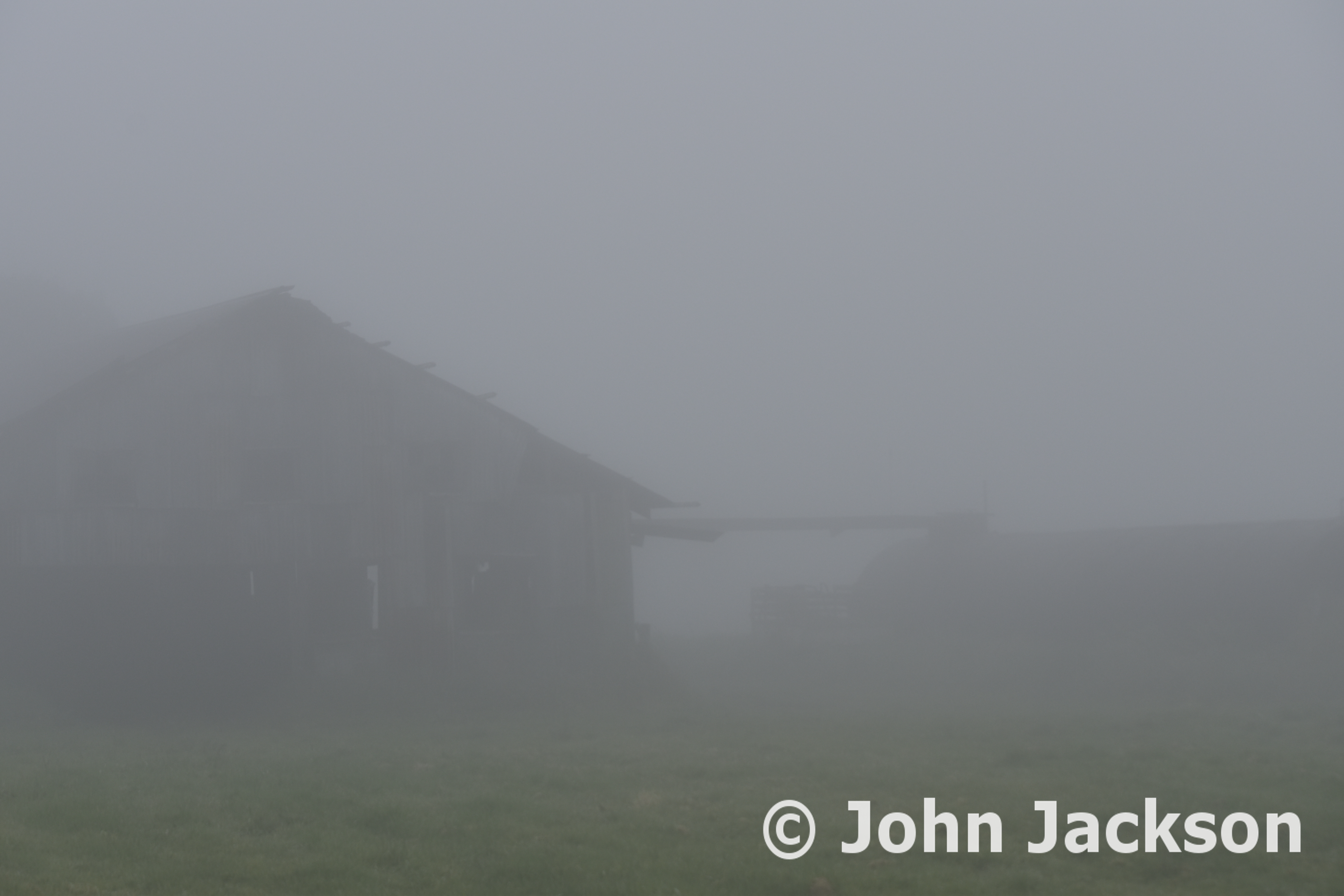
Buildings in the Refuge obscured by fog and volcanic smog (vog)
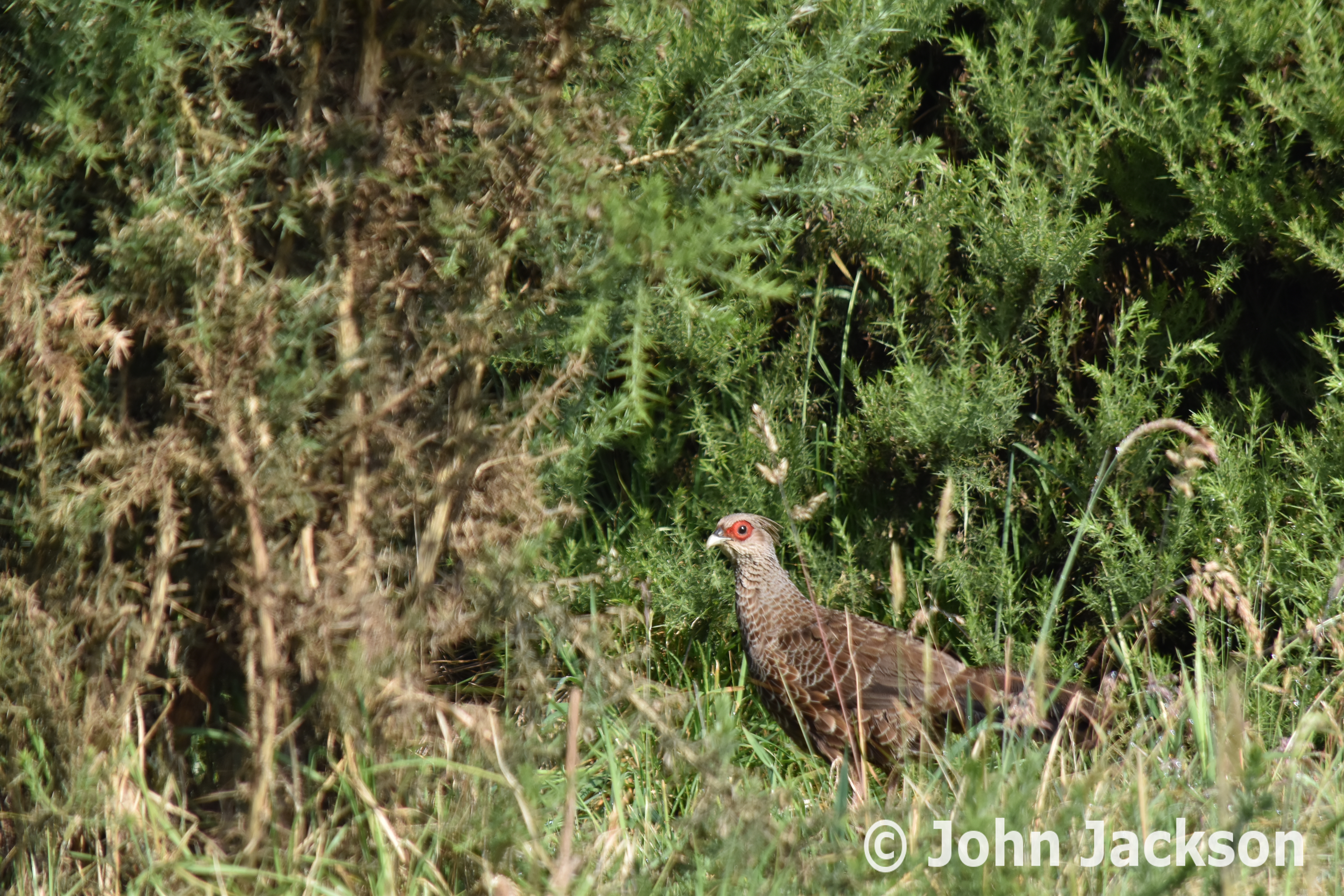
I met my guide in the barren lava fields that stretch between Mona Loa and Mona Kea. The air was chilly. Jack arrived along with another two people. After spraying our footwear down with alcohol, we hopped in an headed for across the street to the Mauna kea access road. This road eventually winds up to the summit of Mona kea and it observatories, but a dirt road that branches off of it leaves around the volcano to ranchland and Hakalau. Dew clung to the grasses as  Erckel's francolins, an African game bird, ran about. Soon the landscape was overtaken with a shrubby brush, this plant called gorsh is dense and adaptable, with seeds able to wait decades to germinate. Without cattle running through and stepping on it the plant has taken over the former ranchlands. Kaji pheasants looked for food along the edge of the plant. We got out and Jack called in a Japanese bush warbler, which remained hidden in the gorsh, but its beautiful calls easily were heard. On the way we past a pathetic reforesting attempt; a couple japanese pine trees growing out of the gorsh. Finally we arrived at the gate and entered Hakalau. After driving down a little hill of recent native Koa replantings we parked in a grassy field that serves as the parking lot.
A female Kaji pheasant. these non-native birds are common in the gorsh grassland on the way to Hakalau
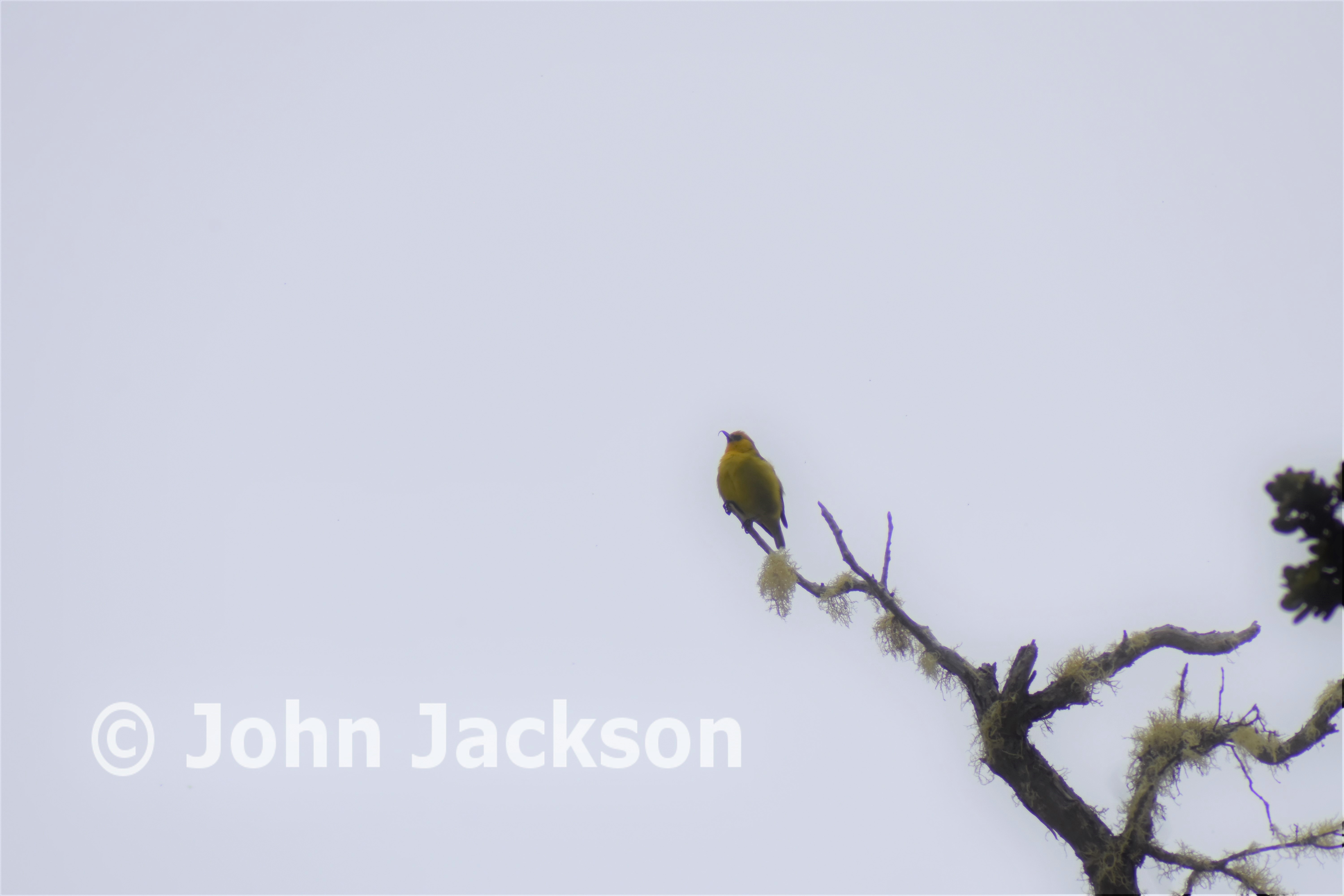
We then began our walk into the older forest, the short Koa began to give way to larger Koa and ancient ohia trees. Despite growing on barren lava fields, ohia don't like to grow in forests until they can be in the shade of the faster growing Koa. We stood for a second listening for native birds, some had flown by but we were yet to actually get a good look at one. Jack then excitedly called is over, on the dead moss covered branches of an ancient tree perched a little yellow bird singing. It was the rarest bird in Hakalau, the ‘Akiapola’au (which is referred to as the Aki, because saying ‘Akiapola’au take too much time). In Hawaiian forests this bird fills the woodpecker niche (eating bugs under the bark or in the wood of trees) and if you know anything about how this niche is filled on remote islands, then you should get excited. Woodpeckers don't get to every island or island group. On the island of Madagascar the Aye-aye, a strange lemur with ever growing teeth, bat-like ears, and a creepy long finger fills it. In the Galapagos and New Caledonia tool using birds probe for grubs. The Aki has a bizarre Beak. The lower mandible is short, thick and sharp, while the upper beak is long, thin, and curved. When feeding it's lower beak is used to drill into the soft Koa wood, and then the upper bill is used to fish the grub out. Besides a weird beak, the Aki also has weird behavior for a passerine. They live in mated pairs that require large territories, and provide parental care for up to two years. Because of its need for Koa forest and susceptibility to disease it is an endangered species, with two populations, one on Mona Loa, and the Hakalau population on Mona Kea. It is the last of a genus of Honeycreepers with extreme overbites.
A Male Aki perched. These unusual passerines are the "Holy grail" of Big Island Birding, and not always seen on trips to Hakalau.
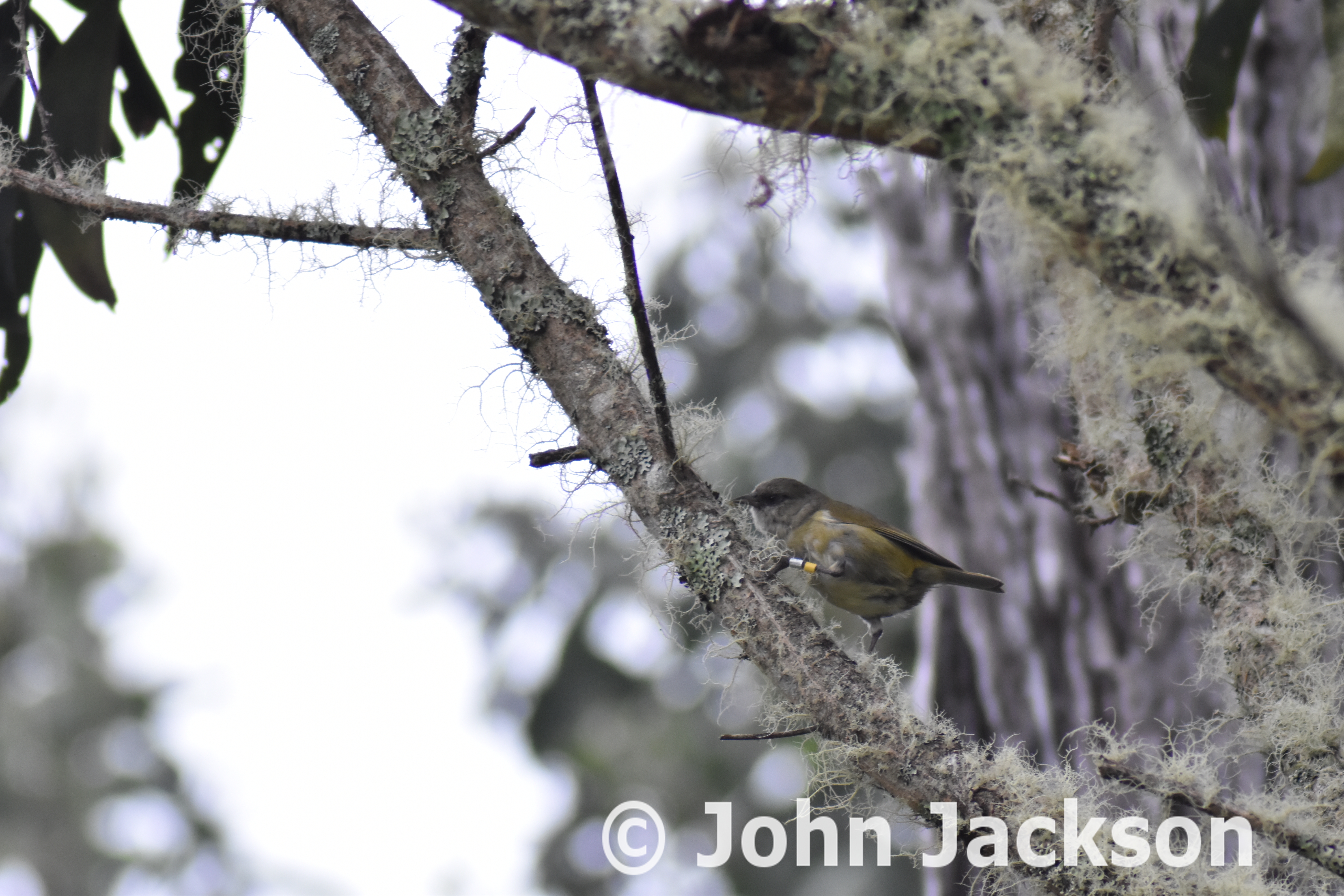
After the Aki had flown off his perch we hung around the spot for a little while, an 'I'iwi flew in but was obscured in an ancient Ohia. More on this bird later. We soon started back down hill in search of more birds. Soon Jack was pointing out a little grey bird clinging to the side of a branch, a Hawaiian Creeper. This drab little bird fills the same niche as nuthatches and creepers on the mainland, picking bugs from moss or just under the bark. The single bird worked its way up a few trees, before flying over and feeding a younger bird.
This Hawaii Creeper has been banded by researchers.
This was June 2018, Kilauea was erupting and Volcanic Smog shrouded the island. Hakalau is also a wet forest at high elevation. The visibility began to drop. Distant Trees became amorphous dark shapes in the background. Hopping around the trees were the ʻōmaʻo, one of two Hawaii's native thrushes that are definitely not extinct. They make a call that can only be described as a police whistle. In the undergrowth the very colorful Red-billed Leiothrix, an asian forest bird, popped out to take a quick look at us. I was also scanning the ferns for two invertebrates I really wanted to see, the Happy-face spider, and carnivorous caterpillars of the genus Eupithecia. No luck, guess I will have to go back.
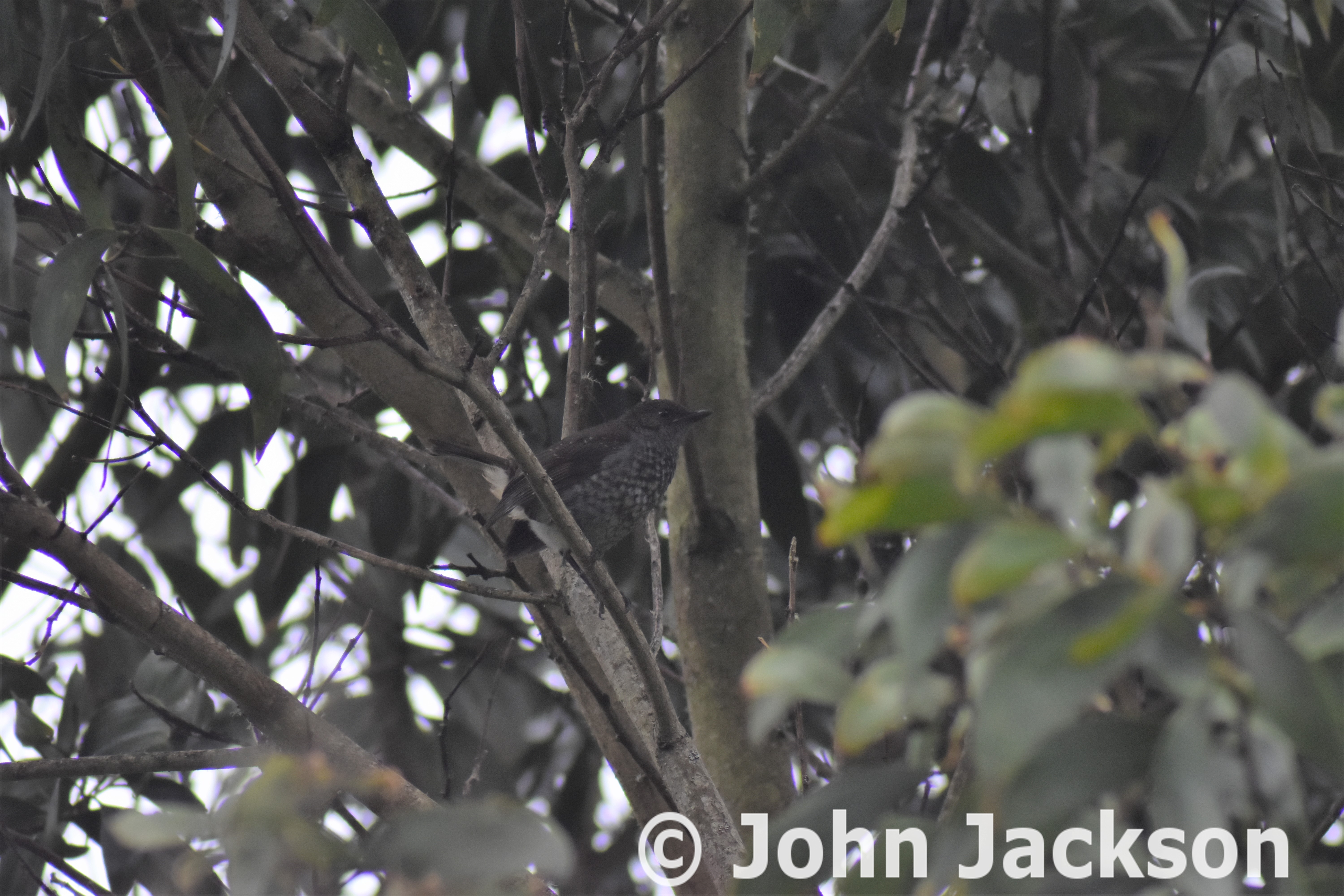
 A juvenile ʻōmaʻo. These are one of two native Hawaiian Thrushes still around; the other is the Puaiohi, which I glimpsed in the remote Alakai swamp of Kauai.

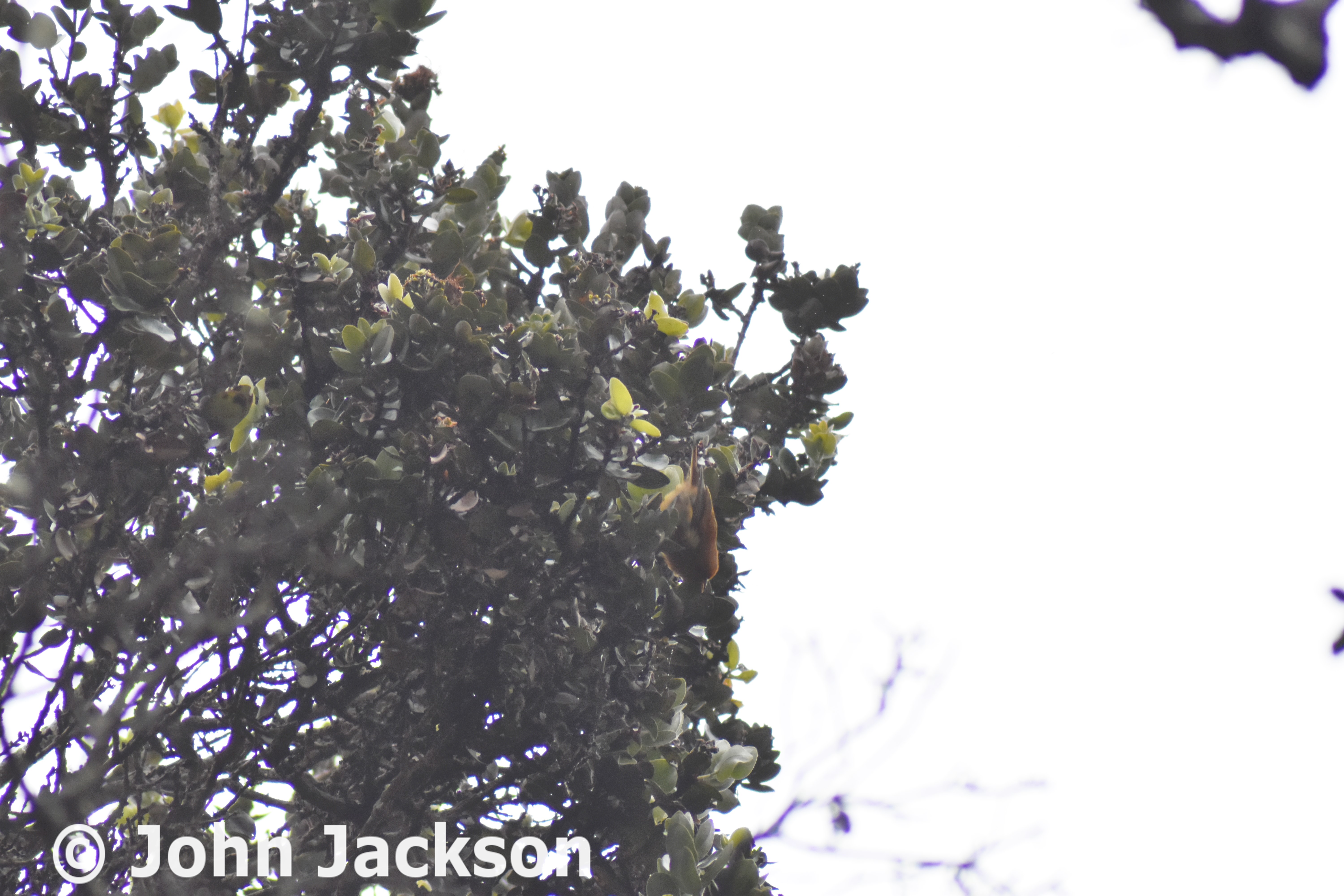
At this point we had picked up the ʻōmaʻo, the ‘elepaio (an old world flycatcher, and among the cutest birds in the world), and all the honeycreepers, save one. The smallest Hawaiian Honeycreeper is a dayglow orange bird with a slightly crossed bill, The Hawai’i ‘Akepa We where some ways down the trail when we arrived in what Jack called a mixed flock. Small green birds with slightly curved bluish bills flitted about, the most numerous Hawaiian Honeycreeper, the Hawaii Amakihi. These birds are one of the few to have started developing resistance to the introduced diseases and can be found at lower elevation. ‘Elepaio hopped on distant branches. Finally Jack pointed up and said “‘Akepa”. On the top of an Ohia tree was a little bird, quite hard to make out. On reviewing my photos, both the crossed bill and orange color are quite obvious. With that we began are hike back up to the car. It began to rain and the mist had dropped visibility even further.
The Bright Orange Hawaii 'Akepa. this little foliage gleaner has a crossed bill and is the only native bird to use cavities.
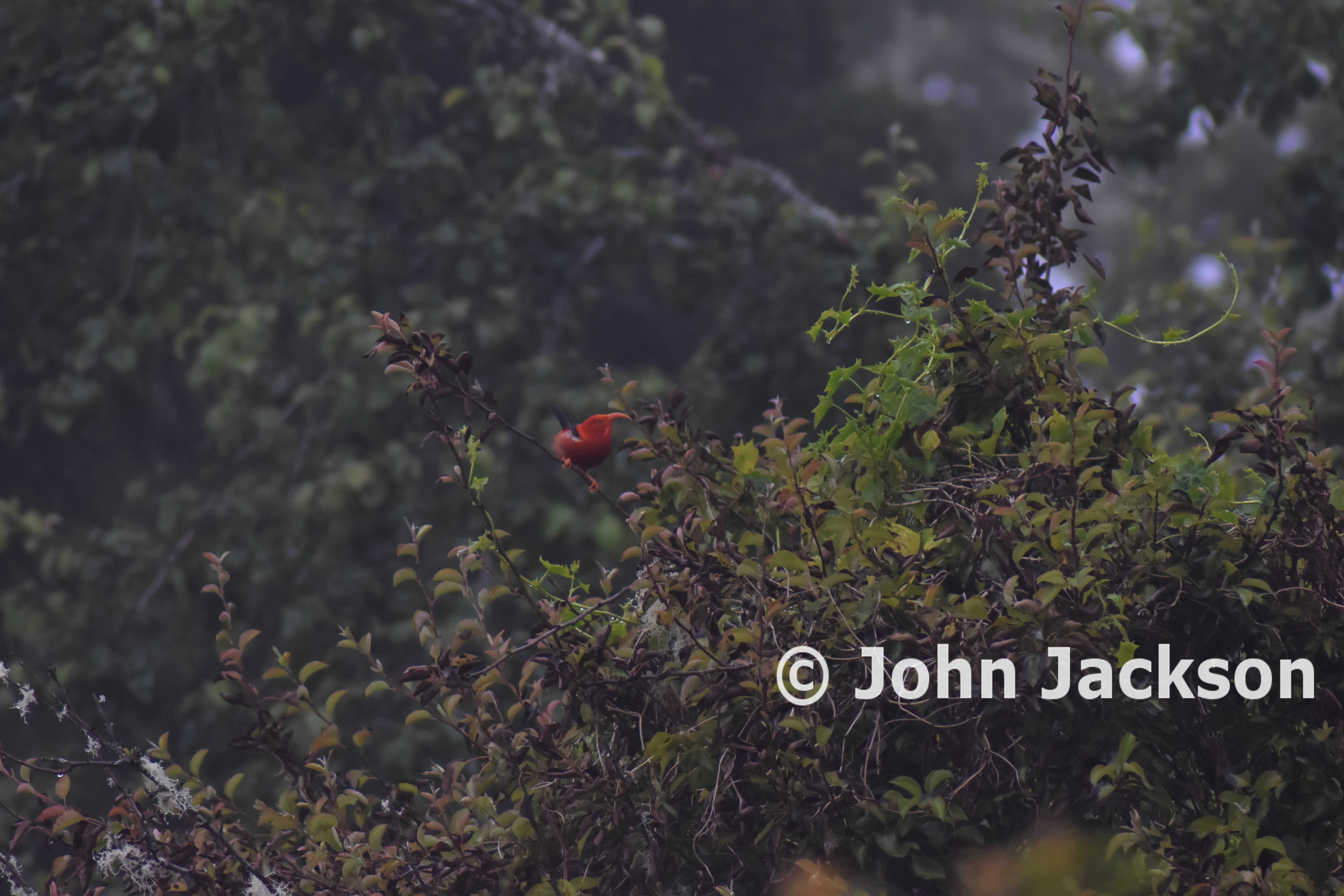
When we  arrived back at the car,  the large building we were parked by was nothing but an outline. My feet were soaked and freezing, but the day wasn’t over yet. We were yet to get a good look at the ‘I’iwi, the scarlet colored hawaiian honeycreeper that had first introduced me to the group in a rainforest book I had as kid. (Well the ʻAkohekohe was also in the book) The ‘I’iwi is a nectar feeder with a long downward curved bill, it used to drink from native Hawaiian lobelioids, but when the introduced land mammals ate them, the ‘I’iwi switched to the Ohia, or in the case of Hakalau behind  the historic Pua Akala Cabin, a massive patch of introduced Fuchsia. We stood out overlooking this mass of vegetation, hardly reminiscent of the small annual plant I see potted in hanging baskets where I live. The ‘I’iwi was calling, they sound a bit like a creaky door. I also found out first hand that the ‘I’iwi name is an onomatopoeia; the bird makes a call, which I don’t think I have ever heard a recording of, which sound like the Hawaiian approximation of it. Another thing to go back and do, get that recording. Then the bird hopped up on a branch above the fuchsia, its bright scarlet contrasted against the dark green foliage. The bird perched in view three times before we had to go and leave this piece of wild Hawaii Behind.
The 'I'iwi perched above the fuchsia plant. This bird is the "posterchild" of Hawaiian Honeycreepers
If you want to help out the birds of Hakalau Forest National Wildlife refuge, donate to Friends of Hakalau Forest NWR, (http://www.friendsofhakalauforest.org/) who have a fund to keep the refuge operational in case of government shutdowns.

Sources
“About the Refuge - Hakalau Forest - U.S. Fish and Wildlife Service.” Official Web Page of the U S Fish and Wildlife Service, www.fws.gov/refuge/Hakalau_Forest/about.html.